
How Pancreatic and Ovarian Cancers Hijack the Body’s Molecular Machinery
Cancer is often viewed as a rogue colony of cells growing out of control. But modern science tells a much more chilling story. A tumor isn’t just a pile of bad cells; it is a corrupted ecosystem.

Cancer is often viewed as a rogue colony of cells growing out of control. But modern science tells a much more chilling story. A tumor isn’t just a pile of bad cells; it is a corrupted ecosystem.
In aggressive cancers like pancreatic and ovarian cancer, the tumor acts like a master manipulator. It doesn’t just grow; it "reprograms" the healthy tissue around it the stroma to act as both a physical fortress and a private fuel station. Understanding this molecular "secret handshake" is the new frontier of 2026 precision oncology.
1. Pancreatic Cancer: Building the Impenetrable Fortress
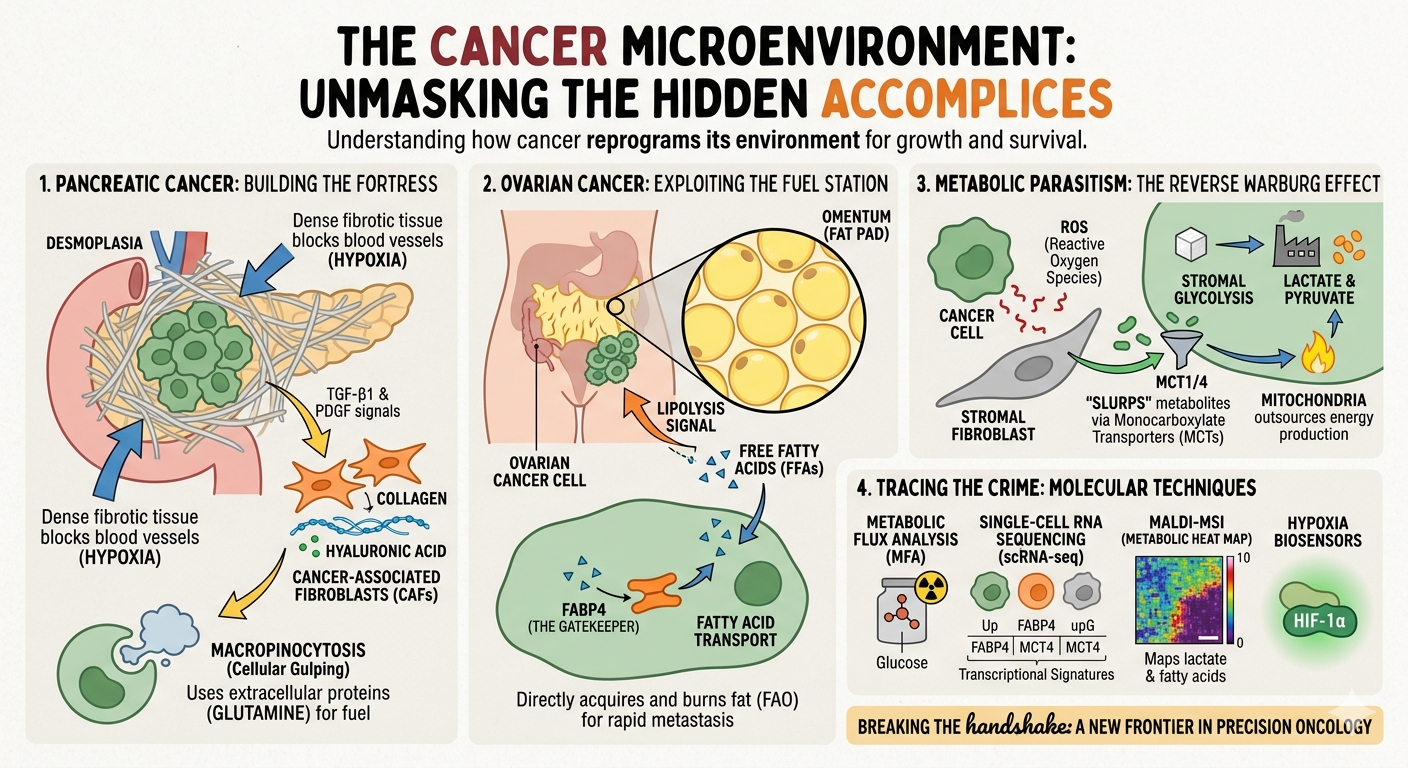
Pancreatic cancer is notorious for its "armored" nature. Up to 90% of the tumor isn't actually cancer; it’s a dense, fibrous wall called desmoplasia.
- The Architect (CAFs): Cancer cells send out "orders" (signals like TGF-\beta1) to nearby healthy cells called fibroblasts, turning them into Cancer-Associated Fibroblasts (CAFs). These CAFs act like frantic construction workers, pumping out massive amounts of collagen.
- The Pressure Cooker: This wall is so thick it creates high internal pressure, literally crushing the local blood vessels.
- The Survival Hack: Because the crushed vessels can't deliver oxygen or food, the cancer "gulps" up nearby proteins through a process called macropinocytosis. It breaks these proteins down into amino acids (like Glutamine) to keep its engine running while everything around it starves.
2. Ovarian Cancer: The All-You-Can-Eat Buffet
As pancreatic cancer constructs a wall, ovarian cancer searches for a "fuel station." It has a biological "hunger" for the huge abdominal fat pad known as the omentum.
- The Lipolysis Signal: Adipocytes, or fat cells, receive signals from the malignancy to begin breaking down their fat as it gets closer to the omentum.
- The Gatekeeper (FABP4): The tumor then produces a "key" called FABP4. This protein acts as a shuttle, grabbing the released fatty acids and dragging them into the tumor.
- High-Octane Fuel: The tumor receives a huge energy boost (ATP) by burning these lipids rather than sugar, which enables it to spread terrifyingly quickly.
3. The "Reverse Warburg Effect": Metabolic Parasites
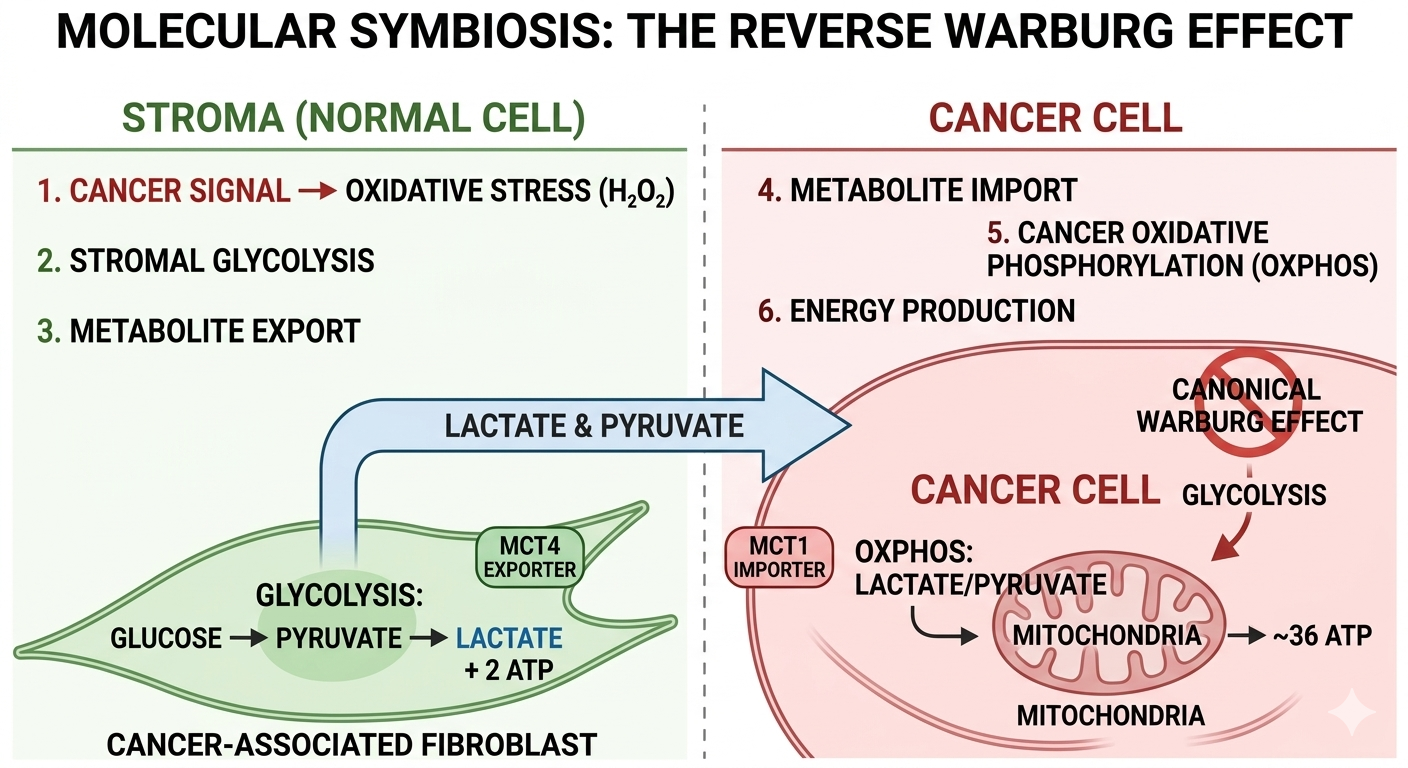
In a brilliant but devastating move, many tumors "outsource" their energy production. This is known as the Reverse Warburg Effect.
- Chemical Warfare: The cancer cell releases "stress" chemicals (ROS) into the surrounding healthy tissue.
- The Forced Labor: This stress forces healthy neighbors to break down sugar into energy-rich scraps like Lactate.
- The Theft: The cancer cell then "slurps" up these scraps using specialized straws called MCT transporters. The cancer acts like a parasite, living off the labor of the very cells it is destroying.
4. Catching the Thieves: How We Trace the Crime
To stop this theft, scientists use high-tech molecular "detective" tools to track where the nutrients are going:
- Metabolic Flux Analysis (MFA): We "tag" nutrients with harmless isotopes to watch where they go. It’s like putting a GPS tracker on a piece of bread to see which cell eventually eats it.
- Single-Cell Sequencing (scRNA-seq): This allows us to listen to the "conversations" of individual cells. We can hear a fibroblast "shouting" that it’s being forced to make fuel for the tumor.
- Metabolic Heat Maps (MALDI-MSI): This creates a colorful "heat map" of a tissue slice, showing exactly where the fat or sugar is being concentrated around the tumor’s edge.
Why This Matters in 2026
We are moving away from just trying to "kill the cancer." The new mission is to starve the fuel station and breach the fortress. By breaking the molecular handshake between the cancer and its neighbors, we can finally leave the tumor out in the open vulnerable, hungry, and much easier to defeat.
Md. Shakibul Alam, Bangladesh
Author, Utopia Educators
References:
1. https://pmc.ncbi.nlm.nih.gov/articles/PMC12287069/?hl=en-US
2. https://www.jci.org/articles/view/191940?hl=en-US
3. https://pmc.ncbi.nlm.nih.gov/articles/PMC12669103/?hl=en-US