
Solid Waste Management and Circular Economy
Solid waste management refers to the systematic control of waste generation, storage, collection, transportation, processing, and disposal. It includes various types of waste such as municipal solid waste, industrial waste, biomedical waste, and electronic waste.

Solid waste management (SWM) has become a critical concern across global, regional, and local scales, owing to its profound implications for environmental sustainability, public health, and climate resilience. With increasing population, industrialization, and consumption, the volume of waste generated globally has risen dramatically. In developing nations, inadequate infrastructure, institutional capacity, and limited financial resources exacerbate waste management issues. Traditional waste management systems, based on a linear take-and-dispose model, are no longer sustainable. Therefore, the alternative concept of a circular economy has appeared as a transformative approach that integrates waste management into a regenerative system.
Concept of Solid Waste Management
Solid waste management refers to the systematic control of waste generation, storage, collection, transportation, processing, and disposal. It includes various types of waste such as municipal solid waste, industrial waste, biomedical waste, and electronic waste.
The key objectives of SWM are:
- Protection of public health.
- Environmental sustainability.
- Resource conservation.
- Aesthetic improvement of urban areas.
Traditional methods such as landfilling and open dumping are still widely practiced in many developing countries, including Bangladesh. However, these methods cause soil contamination, groundwater pollution, and greenhouse gas emissions.
Challenges in Conventional Waste Management
Some major challenges of conventional waste management are:
- Rapid urbanization and population growth
- Lack of segregation at source.
- Weak regulatory enforcement
- Public awareness gaps
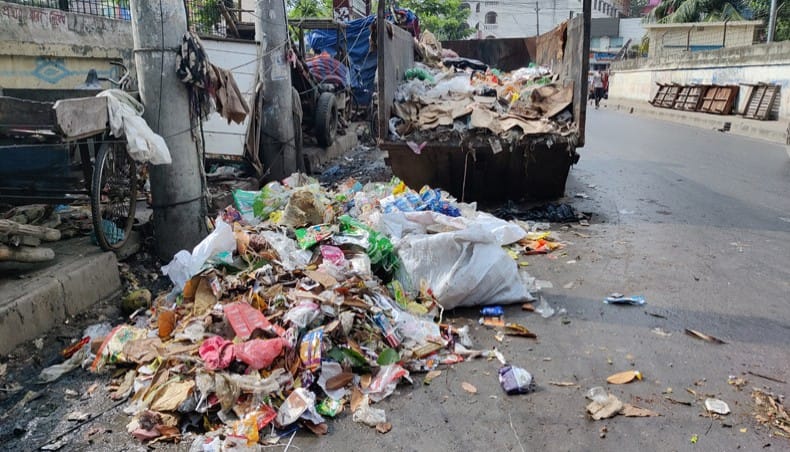
For example, we have seen a weak solid waste management system and lack of awareness of people. They throw their waste into the road, which leads to the drainage blockage, and water can't move properly.
Circular Economy: Concept and Principles
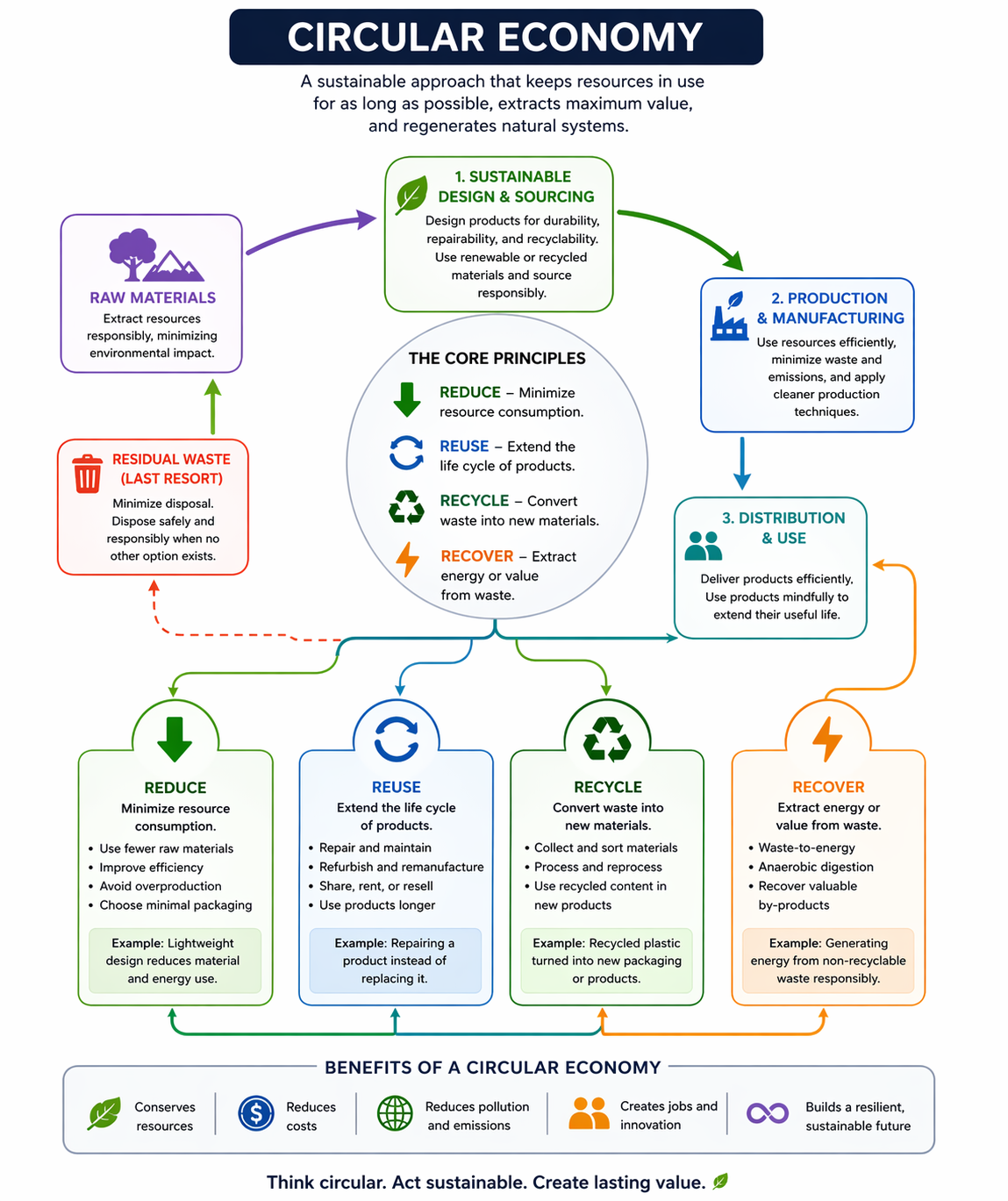
The circular economy is an alternative economic model that aims to eliminate waste and promote the continuous use of resources. Unlike the linear economy, the circular economy follows a closed-loop system.
The core principles of a circular economy include the following:
Reduce – Minimize resource consumption.
Reuse – Extend the life cycle of products.
Recycle – Convert waste into new materials.
Recover – Extract energy or value from waste.
The circular economy emphasizes designing products for durability, repairability, and recyclability.
Relationship Between Solid Waste Management and Circular Economy
Solid waste management and the circular economy are closely interconnected concepts that work together to promote sustainability and efficient resource use. Solid waste management focuses on the proper collection, treatment, recycling, and disposal of waste to minimize environmental and health impacts. On the other hand, the circular economy is a broader approach that aims to reduce waste generation by keeping materials and resources in use for as long as possible through reuse, recycling, and recovery. In this relationship, solid waste management acts as a practical system that supports the goals of the circular economy by enabling recycling processes, reducing landfill dependency, and recovering valuable materials from waste. At the same time, the circular economy improves solid waste management practices by encouraging waste reduction at the source and transforming waste into useful resources. Together, they contribute to environmental protection, economic efficiency, and sustainable development.
Integration of SWM and Circular Economy
Solid waste management plays a crucial role in achieving a circular economy. Instead of viewing waste as a burden, the circular economy treats it as a valuable resource.
Key integration strategies:
i. Waste Segregation at Source: Proper separation of organic, recyclable, and hazardous waste improves recycling efficiency.
ii. Composting and Biogas Production: Organic waste can be converted into compost or energy, reducing landfill dependency.
iii. Recycling Systems: Materials like plastic, glass, and metals can be reprocessed and reintroduced into production cycles.
iv. Waste-to-Energy (WtE): Technologies such as incineration and anaerobic digestion can generate electricity from waste.
v. Extended Producer Responsibility (EPR): Manufacturers are made responsible for the lifecycle of their products.
A Case Study at Dhaka City
Dhaka generates thousands of tons of solid waste daily. The majority is organic waste, which has high potential for composting and energy recovery. However, limited segregation and reliance on landfill sites like Matuail hinder efficient resource recovery.
Adopting circular economy strategies in Dhaka could:
· Reduce landfill pressure.
· Create employment in recycling sectors.
· Improve environmental quality.
· Enhance urban sustainability.
Benefits of Circular Economy in Solid Waste Management (SWM)
· Reduction of environmental pollution
· Conservation of natural resources
· Economic benefits through resource recovery
· Job creation in recycling and green industries
· Lower greenhouse gas emissions
The integration of solid waste management with circular economy principles is essential for sustainable development. Transitioning from a linear to a circular system requires policy support, technological advancement, and public awareness. For developing countries like Bangladesh, adopting circular economy practices in waste management can significantly improve environmental conditions while promoting economic growth.
-Shihab Shahriar Soyeb, Bangladesh
Author, Utopia Educators
References:
- Ellen MacArthur Foundation. (2013). Towards the circular economy: Economic and business rationale for an accelerated transition. Ellen MacArthur Foundation.
- Ellen MacArthur Foundation. (2019). Completing the picture: How the circular economy tackles climate change. Ellen MacArthur Foundation.
- Hoornweg, D., & Bhada-Tata, P. (2012). What a waste: A global review of solid waste management. World Bank.
- Islam, M. S. (2016). Solid waste management in Bangladesh: Issues and challenges. Journal of Environmental Science and Natural Resources, 9(2), 39–44.
- Kirchherr, J., Reike, D., & Hekkert, M. (2017). Conceptualizing the circular economy: An analysis of 114 definitions. Resources, Conservation and Recycling, 127, 221–232. https://doi.org/10.1016/j.resconrec.2017.09.005
- Kaza, S., Yao, L., Bhada-Tata, P., & Van Woerden, F. (2018). What a waste 2.0: A global snapshot of solid waste management to 2050. World Bank.
- United Nations Environment Programme (UNEP). (2015). Global waste management outlook. UNEP.
- Wilson, D. C., Velis, C., & Cheeseman, C. (2006). Role of informal sector recycling in waste management in developing countries. Habitat International, 30(4), 797–808. https://doi.org/10.1016/j.habitatint.2005.09.005.