
The Mystery of the Giza Pyramids: Were They Built with Geopolymer Concrete?
An analysis of the different theories of how the blocks used in the Pyramids were created.


The pyramids are the most iconic and mysterious structures made by humans. These monumental constructions are mostly associated with ancient Egypt, though there are some similar structures that were built in the other part of the world. The construction of the Great Pyramids of Giza remains an enduring mystery, sparking debate among historians, archaeologists, and engineers for centuries. There are several pyramids in Egypt; however, the largest of these is the Great Pyramid of Giza, which is located in the Giza Plateau, near the Nile River. The Pyramid of Giza, also known as the Pyramid of Khufu, was built around 2600 BCE. The height of the Giza is about 146.6 meters (481 ft) and was the tallest human-made structure in the world for more than 3,800 years.
The pyramid is the oldest of the Seven Wonders of the Ancient World and the only wonder that has remained largely intact. The pyramids were constructed using millions of limestone and granite blocks, some weighing several tons. Despite the lack of modern machinery or equipment, the ancient Egyptians used ingenious methods to build the pyramid that is completely undiscovered. Pyramids are not just ancient tombs but also powerful symbols of human ambition, engineering excellence, and spiritual belief.
In today’s article, I will discuss how the pyramids were built, focusing on the materials used and the construction methods involved, and also explore whether they were constructed using geopolymer materials.
Davidovits's Theory:
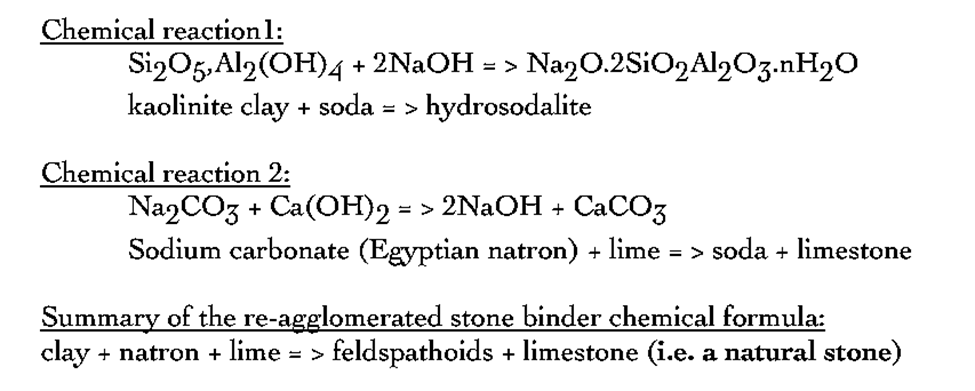
In 1978, the French chemist Joseph Davidovits proposed that the pyramid is not made by using the understood method described by geologists, historians, or archeologistss but rather by the concrete blocks that are molded on-site. According to Davidovts, these concrete blocks were cast in situ. The concrete blocks were constructed by the combination of water, lime, zeolite, and sand, forming materials such as kaolin, silt, and natron (sodium carbonate). All the materials are poured into a wooden mold to provide the desired shape and edges. The water helps separate clay from limestone, while the alkaline solution from lime/ash dissolves alumino-silicates. Over time, these react with alkali hydroxides to form binding compounds (poly-silico-oxo-aluminates), which are known as geopolymers that act like glue.
Egyptologists also agree that most pyramid core blocks were made from limestone, while the smoother inner and outer casings were made from finer limestone. The sources of the limestones are likely from the Tura quarries on the east side of the Nile. X-ray fluorescence and X-ray diffraction have shown that the blocks consist of limestone (85 to 92%) associated with a binder. The central part is identified as natural limestone, but the outer part contains a large amount of F, Na, Mg, Al, and Si.
Evidence from the Lauer Sample:
Basically, the Lauer sample is a small fragment taken from the pyramid and studied by the researchers, including J. Davidovits. He analyzed the microstructure and chemical composition of the Lauer sample. The analysis showed that the Tura samples were chemically and structurally different, suggesting they were not the direct source of quarried casing stones for the pyramid.
Based on J. Davidovits, the pyramid blocks are made of calcite aggregate held together with a silica-based binding phase, and Si should be ubiquitous in the "grain boundary" areas (the area between calcite or other aggregates). Based on Lauer's sample result, the ubiquity of Si is clear. It appears combined with elements like Mg, Ca, S, P, and Al in different samples, including the Lauer sample. Many of these regions show signs of hydration due to the presence of metal-rich materials that are not indigenous to the natural limestone aggregate. But researchers argue that Si is a geologic element, so it can be found everywhere.
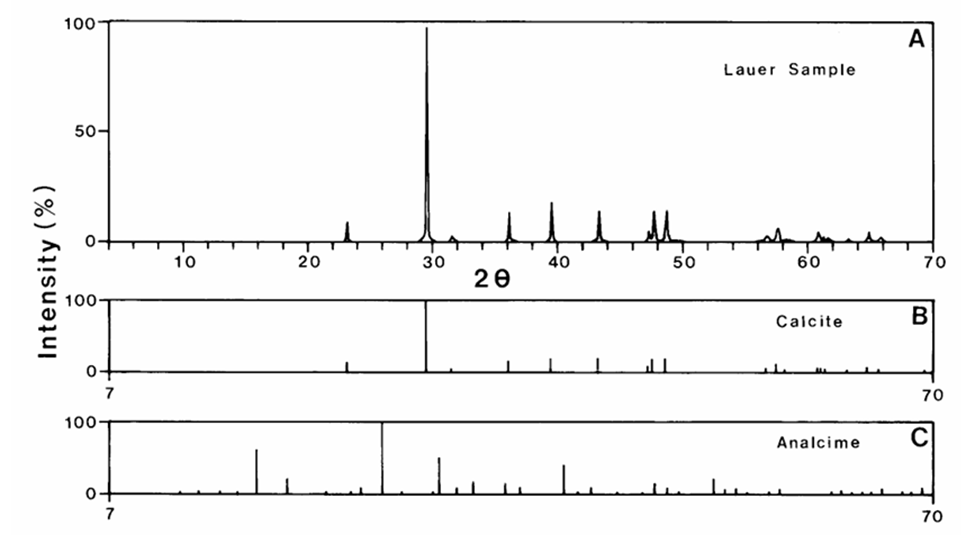
XRD result: The XRD result shows that the pattern for the Lauer sample matches almost perfectly the pattern for calcite. It was concluded based on the XRD analysis that the Lauer sample consists of at least 95 percent calcite with no trace of zeolite cement.
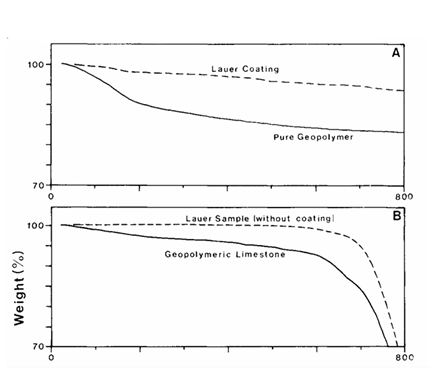
EDS and TGA result: The EDS result showed no significant silicon or aluminum peaks were detected, indicating less possibility of the presence of zeolites. The results indicate the coating is likely apatite (Ca₅(PO₄)₃(OH,F,Cl)) or possibly brushite (CaHPO₄·2H₂O). According to JD, analcime and other zeolites contain chemically bound water, and there should be 2-3 percent weight loss from chemically bound water. The TGA curves for the Lauer sample, however, showed no such weight loss indicative of bound water but release of carbon dioxide from the decomposition of calcium carbonate, a characteristic behavior of natural limestone.
In-Situ Casting of Composite Blocks: There is a possibility that the pyramids were built with the cast-in-situ process due to the abundant source of limestone near the pyramids. The limestone was extracted from the El Mokattam Mountain in Wadi Hof with a manageable size. Later it was transported to the construction site using boats or wagons. The limestone was roasted at the construction site to produce calcium hydroxide. The dry mixtures of calcium hydroxide powder and sand were packed into flexible reed bags, known as "Koffa." Water was transported from the Nile River through a canal. Water was lifted to the pyramid using buckets and shadufs. Based on the findings, it can be concluded that the Egyptians possessed advanced construction techniques and successfully overcame significant logistical challenges in building the pyramids.
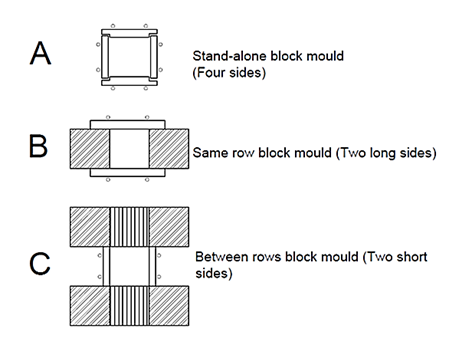
Block Mould Type: The study introduces 3 types of wooden moulds that were used by the Egyptians for the construction of the pyramids. These were (i) a four-sided mould used at the beginning of the casting process (type A), (ii) two long-sided mould for row filling (type B), and (iii) two short-sided mould for interlocking gaps (type C). The various wooden mould types are shown below.
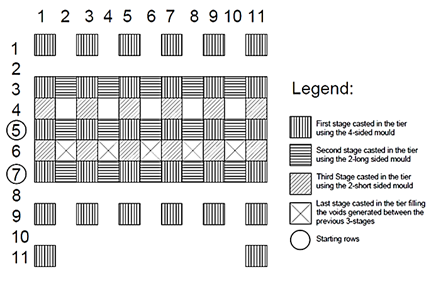
Chessboard Method: The precise placement and fitting of the blocks in the construction of the pyramids suggest that the Ancient Egyptians may have employed a matrix approach similar to a checkerboard to achieve an exact block molding sequence.
The study proposes that each pyramid tier was organized into a grid with an odd number of rows and an equal number of columns. The construction process mostly started with the placing of four-sided moulds (Type A) at the outer corners of the tier to define the boundaries. After the casting, the moulds were positioned at the intersections of the odd-numbered rows and odd-numbered columns.
After the initial blocks were set, two long-sided moulds (Type B) were used to fill gaps along odd-numbered rows, which created continuous lines of blocks. Then, short-sided moulds were applied to fill gaps between even numbers of rows and odd numbers of columns, and finally, the remaining spaces were completed. This systematic, chessboard-like approach ensured precise alignment, strong interlocking, and uniformity throughout the pyramid tier.
Despite extensive research and experimental studies, the exact methods used to construct the Giza pyramids remain uncertain. While traditional theories suggest the use of quarried and transported limestone blocks from the Tura limestone quarries, Davidovits proposed that the blocks may have been cast in place using a lime- or alkali-based mixture. There were various theories proposed to explain the construction techniques used to build the great pyramids by Egyptians, including the use of ramps, sledges, ropes, and even water for transporting the massive stone blocks that were likely carved from nearby mountains.
In conclusion, the true method behind the Giza pyramids remains a mystery that continues to challenge our understanding of ancient ingenuity.
-Ariful Islam
Bangladesh
References:
- Harrell, J. A., & Penrod, B. E. (1993). The great pyramid debate–Evidence from the Lauer sample. Journal of Geological Education, 41(4), 358-363.
- Barsoum, M. W., Ganguly, A., & Hug, G. (2006). Microstructural evidence of reconstituted limestone blocks in the Great Pyramids of Egypt. Journal of the American Ceramic Society, 89(12), 3788-3796.
- Škvára, F. R. A. N. T. I. Š. E. K., Svoboda, P., DOLEŽAL, J., BITTNAR, Z., ŠMILAUER, V., KOPECKÝ, L., & ŠULC, R. (2008). Geopolymer concrete-an ancient material too?. Ceramics− Silikáty, 52(4), 296-298.
- BAKIR, R., Bakir, R., & Bakir, A. (2024). Great Pyramid Construction: In-Situ Casting of Composite Blocks. International Journal of Multidisciplinary Studies in Architecture and Cultural Heritage, 7(1), 54-66.
- Folk, R. L., & Campbell, D. H. (1992). Are the pyramids of Egypt built of poured concrete blocks?. Journal of Geological Education, 40(1), 25-34.
- Davidovits, J., & Morris, M. (2009). Why the pharaohs built the Pyramids with fake stones. Institut Géopolymère.
- Great pyramid of Giza: wikipedia