
Mechanical Properties of Geopolymer Concrete
Exploring the factors affecting the strengths of geopolymer concrete such as curing conditions, activator-to-binder ratio, water content, mix design, mixing process, mixing time.

Maybe you have heard the term “geopolymer concrete." Geopolymer concrete has emerged as a sustainable and eco-friendly alternative to the conventional construction process.
However, we need to understand the properties of geopolymer because without knowing these properties, no one will be interested in applying geopolymer concrete for their construction work.
There are several parameters that must be tested before the construction work, such as physical properties of the materials (sand, stone, admixture, activators), mechanical properties, and durability properties. In addition, environmental assessments such as carbon footprint analysis and life cycle assessment (LCA) are crucial to determine the overall sustainability of geopolymer concrete.
Mechanical properties describe how a material acts when subjected to different types of forces, such as compressive, tensile, and flexural. These mechanical properties indicate the strength, stiffness, and deformation characteristics of a material under load.
The term ASTM, which stands for American Society for Testing Materials, is an organization that creates standard rules and test methods. In simple terms, ASTM is a global standard system for testing and quality control of materials. One of the most important properties of concrete or mortar is compressive strength, which is conducted by ASTM C39 or C109. Tensile strength measures the resistance to pulling or stretching forces per unit area within a material that is tested by ASTM C496, and the flexural strength reflects the material’s ability to resist bending, tested by ASTM C78. The compressive strength describes the ability of a material to resist crushing loads per unit area of the sample.
In today’s article, I will briefly discuss the mechanical properties of geopolymer concrete. I have already discussed the geopolymer concrete in the previous article:
 Ariful Islam
Compressive Strength: The compressive strength of geopolymer concrete depends on the activator-to-binder ratio, water content, mix design, mixing process, mixing time, curing condition, etc. Several studies showed that geopolymer has comparable or higher compressive strength compared to OPC. Guo et al. reported the compressive strength of 63.4 MPa found for a class C fly ash-based geopolymer concrete (GPC), but the compressive strength decreases with an increase in the water-geopolymer solids ratio. Nath et al. reported that the inclusion of slag in the fly ash-based GPC resulted in higher compressive strength. The molarity of the NaOH solution significantly affects the strength of GPC; as the molarity of NaOH increases, the strength of GPC also increases. The curing temperature also influences the strength development of geopolymer concrete. The higher curing temperature exhibited the higher strength, but when cured at room temperature, the compressive strength is slightly less.
It should be noted that an extended curing time can enhance the geopolymerization mechanism and improve strength. However, a longer duration of curing at an elevated temperature results in failure of the concrete. Higher initial curing temperature and duration resulted in higher compressive strength. A study said that the optimum heat curing regime was found to be at 120°C for 20hr, but several authors examined other curing temperatures and curing times. According to studies, the optimum temperature could be 80°, 100°, 60°, etc. Overall, it is found that the optimum curing temperature is 60°C-100°C. According to Nguyen et al., increasing the water-to-solid ratio from 0.2 to 0.3 decreases the compressive strength of the FA-based geopolymer concrete for alkaline-to-binder ratios of 0.3 and 0.4. The blending ratio of Na₂SiO₃/ NaOH also influenced the strength development of geopolymer concrete, and an optimum blending ratio was found to be 2.5, according to several studies. The maximum compressive strength was found with 100% slag, and if fly ash, POFA, volcanic ash, or red mud is partially replaced, the GPC reduces its compressive strength. The replacement of fly ash with silica fume up to 40% was found to be helpful to enhance compressive strength. The amount of superplasticizer should be limited to get the maximum compressive strength. Usually, 1-4% superplasticizer is used for GPC, but most of the authors used 1-2% superplasticizer.
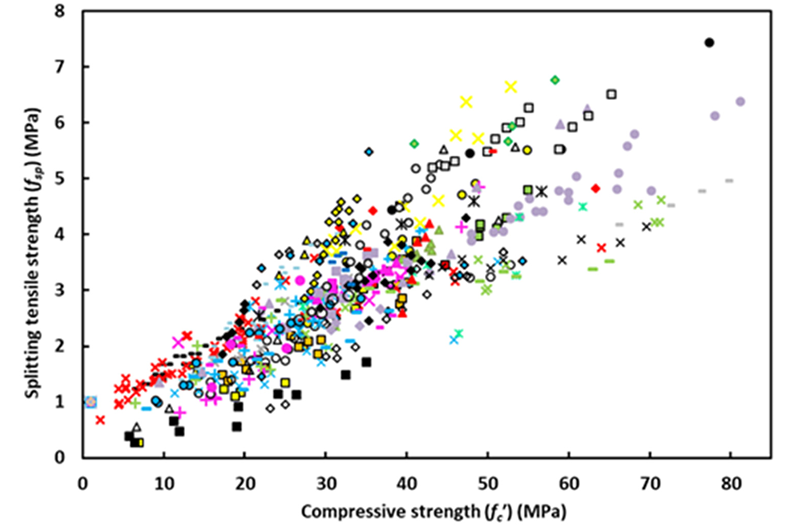
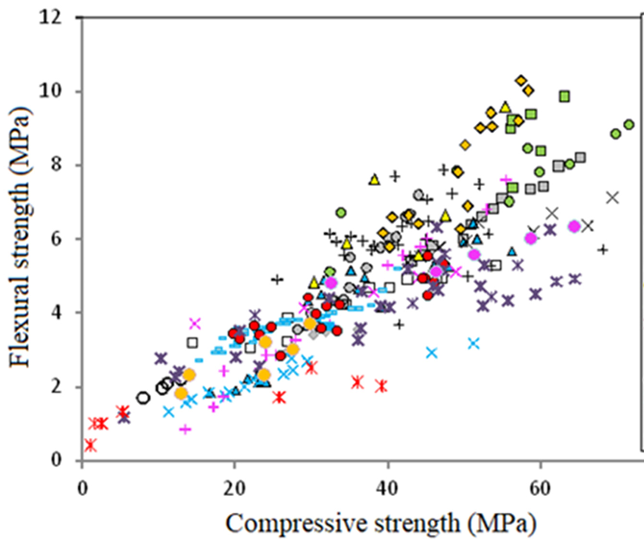
Split Tensile and Flexural Strength: The split tensile and flexural strength follow the similar factors as compressive strength, as they also depend on mix design, curing temperature and time, activator content, molarity of NaOH, etc. If the compressive strength increases in a mix, the corresponding tensile and flexural strength also increases. The flexural strength of geopolymer concrete is found to be 1.4 times higher, and the split tensile strength 8%-12% greater than that of OPC concrete. The combination of slag and fly ash as precursors increased both tensile strength by about 20% and flexural strength compared to OPC concrete. The flexural strength of 12 MPa and tensile strength of 6 MPa were found within the activator-to-binder ratio of 0.35 to 0.40 and curing temperature of 60°C-80°C for 24 hrs. The increase in sodium hydroxide concentration in the mix has a favorable influence on tensile strength. Tensile strength generally increases up to about 200°C but decreases over 800°C. The increasing slag replacement (from 15% to 20%) in fly ash-based mixtures leads to a decrease in flexural strength, even though compressive strength improves with this change. When the 50% fly ash is replaced with slag, the split tensile strength is significantly enhanced.
-Ariful Islam
Bangladesh
References:
- Chowdhury, S., Mohapatra, S., Gaur, A., Dwivedi, G., & Soni, A. (2021). Study of various properties of geopolymer concrete–A review. Materials Today: Proceedings, 46, 5687-5695.
- Ramesh, V., & Srikanth, K. (2020). Mechanical properties and mix design of geopolymer concrete–A review. In E3S web of conferences (Vol. 184, p. 01091). EDP Sciences.
- Hassan, A., Arif, M., & Shariq, M. (2019). Influence of microstructure of geopolymer concrete on its mechanical properties—A review. Advances in Sustainable Construction Materials and Geotechnical Engineering: Select Proceedings of TRACE 2018, 119-129.
- Ma, C. K., Awang, A. Z., & Omar, W. (2018). Structural and material performance of geopolymer concrete: A review. Construction and Building Materials, 186, 90-102.
- Mohammed, A. A., Ahmed, H. U., & Mosavi, A. (2021). Survey of mechanical properties of geopolymer concrete: A comprehensive review and data analysis. Materials, 14(16), 4690.
- Rihan, M. A. M., Onchiri, R. O., Gathimba, N., & Sabuni, B. (2024). Effect of elevated temperature on the mechanical properties of geopolymer concrete: a critical review. Discover Civil Engineering, 1(1), 24.
- ElKhatib, L., Al Aridi, F., ElKordi, A., & Khatib, J. (2022). Mechanical and durability properties of geopolymer concrete–a review. BAU Journal-Science and Technology, 3(2), 8.