
Environmental Impact Assessment of Geopolymer Concrete: How Eco-Friendly Is It?
According to the recent research, the global warming potential of GPC is 10-70% lower compared to the OPC concrete. The CO₂ footprint of geopolymer concrete was approximately 9% lower in comparison to concrete containing 100% OPC binder.

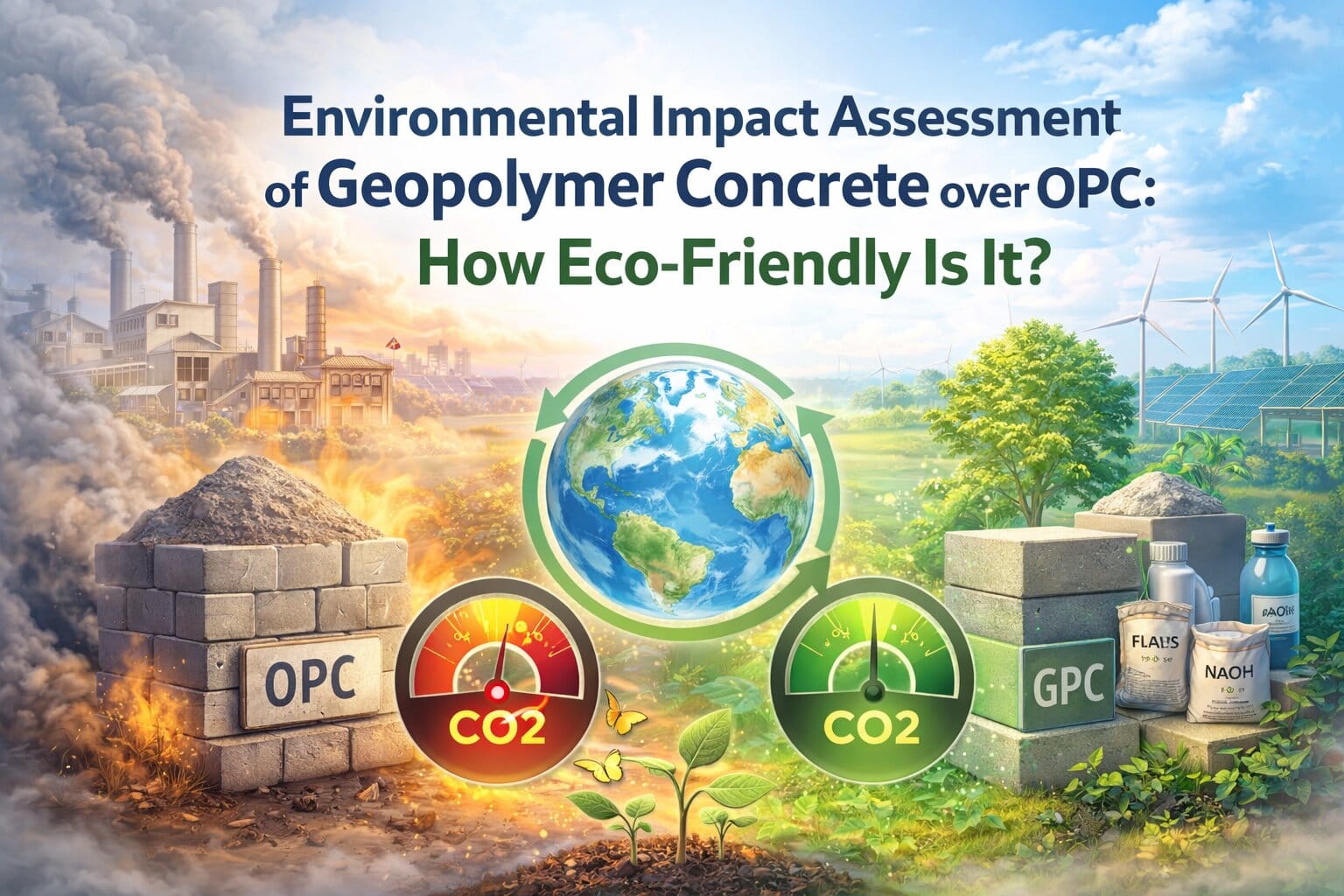
Geopolymer concrete (GPC) has emerged as a promising sustainable and eco-friendly alternative to OPC concrete, offering a significantly lesser carbon footprint, better mechanical performance, and enhanced resource efficiency. The cement industry is responsible for 6-9% of global CO2 emission and approximately 0.8 to 0.9 tons of CO₂ are emitted per ton of cement production. The blended cements (such as cement + fly ash/slag/agricultural ash) reduced CO₂ emissions approximately by 13-22%, but these emissions can vary depending on the raw material sources, binder quantity, amount of OPC replacement, energy source, transportation distance, etc.
Life Cycle Assessment (LCA) of geopolymer concrete:
The global warming impact of different gases is determined by the Global Warming Potential (GWP), and it is the widely used tool to make comparisons of the emission of any gas with CO₂ emission over a specified time interval. The GWP is measured by the life cycle assessment (LCA). Life Cycle Assessment (LCA) is a comprehensive method used to assess the environmental effects linked to production and utilization across the entire life cycle from cradle to grave. LCA evaluates all the resources used in both OPC and GPC to calculate the GWP. The production of geopolymer concrete reduced the effect on global warming compared to the standard OPC concrete.
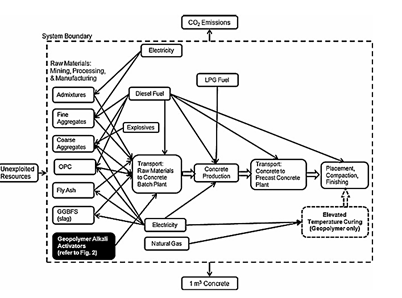
The geopolymer concrete (GPC) possesses lower global warming potential when compared to Ordinary Portland Cement (OPC) concrete. The Intergovernmental Panel on Climate Change (IPCC) stated that GPCs containing various binders have considerably lower impact on global warming potential compared to the OPC concrete, and the result is verified by the different researchers, as they also found that the GPC produces lower CO₂ emissions to the environment than OPC. The GWP of geopolymer concrete exhibited 64% lower when compared to OPC concrete due to the use of sustainable NaOH that is obtained from the solar salt, according to Salas et al. Structures constructed with geopolymer concrete (GPC) and reactive powder concrete (RPC) generally showed comparatively lower Global Warming Potential (GWP) and also increased durability and longer design life compared to those made with ordinary Portland cement (OPC) concrete.
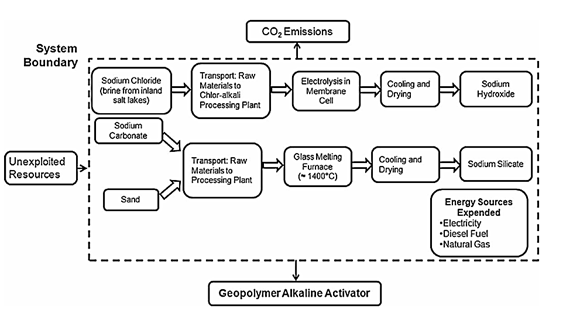
The types of binder (precursors + activator) extremely affect the environmental impact due to the chemical composition of the binder and the amount of silicate used in the mixtures. Fly ash and slag-based geopolymer concrete has a lower environmental impact compared to metakaolin (MK)-based GPC due to the lower amount of silicate used in fly ash and slag-based GPC. If a higher amount of silicate is used in the mix, the GWP will be higher. According to the recent research, the global warming potential of GPC is 10-70% lower compared to the OPC concrete. The CO₂ footprint of geopolymer concrete was approximately 9% lower in comparison to concrete containing 100% OPC binder.
Effect of Alkaline Activators:
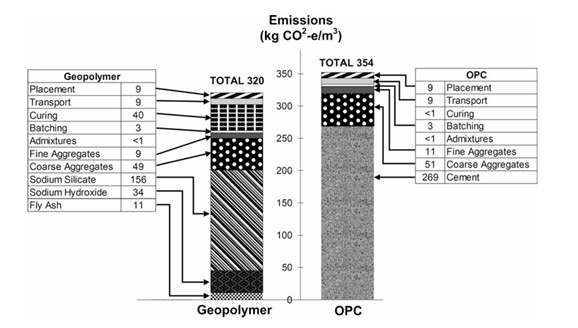
The alkaline activators, such as NaOH and Na₂SiO₃, play a vital role in GPC because of the binding property. Na₂SiO₃ solution is responsible for 65% of GPC’s global warming potential, while another study suggested that the solution accounts for 57% of GPC’s GWP. The production of NaOH varies significantly in terms of environmental impact. The optimum activator content, concentration, and their blending ratio (SS/SH) are required to reduce the CO₂ emissions. A study suggested that reducing SS/SH from 4.0 to 2.0 decreases the GWP by 23%. The direct influence of NaOH concentration on CO₂ emissions is lower, about 2.4%, compared to the indirect influence. It was identified by a study that the maximum compressive strength of 59.2 MPa was observed with an optimal SS/SH value of 2.0.
Effect of the strength:
The different grades of geopolymer concrete exhibited significant variation in GWP compared to PCC due to the types of dosage and solid precursors. High-strength geopolymer mixtures containing slag as source material can achieve up to 50% lower emissions than PCC. The main benefit of using slag is its high calcium content and strong binding properties that ensure excellent mechanical properties. The metakaolin-based concrete achieves at least a 61% reduction in GWP compared to OPC concrete. The theoretical heat required to produce metakaolin from pure kaolinite is about 1145 kJ/kg, which is approximately 36% lower than that of PC clinker. The high curing temperature of geopolymer concrete accounts for 12.4% of total emissions, whereas OPC cured at ambient temperature that generates negligible CO₂.
Although GPC has a lesser impact on global warming, it still poses environmental issues like freshwater ecotoxicity, marine toxicity, abiotic depletion, and eutrophication. These impacts are highly influenced by the type of binder and activator used.
References:
1. Ou, Y. (2025). A review of the life cycle assessment of geopolymer concrete. Advances in Engineering Technology Research, 15(1), 1711-1711.
2. Imtiaz, L., Rehman, S. K. U., Ali Memon, S., Khizar Khan, M., & Faisal Javed, M. (2020). A review of recent developments and advances in eco-friendly geopolymer concrete. Applied sciences, 10(21), 7838.
3. Mlinde, A. (2024). Life Cycle Assessment of Geopolymeric Materials (Master's thesis, Instituto Politecnico de Leiria (Portugal)).
4. Turner, L. K., & Collins, F. G. (2013). Carbon dioxide equivalent (CO2-e) emissions: A comparison between geopolymer and OPC cement concrete. Construction and building materials, 43, 125-130.
5. Hasan, M. J., Islam, A., Sutradhar, A., & Aziz, A. M. (2026). Suitability of alkali activated material as sustainable alternate binder: A comprehensive review.